The Biggest Pokémon Card Sales of 2026 — What Sold and For How Much
From a $6 million Pikachu to six-figure Base Set holos, Pokémon cards have become serious collectibles and investments. Here's the definitive breakdown of the most expensive Pokémon cards ever sold — with real prices, PSA population data, and live recent auction results.
- The most expensive Pokémon card ever sold is the Pikachu Illustrator at $6 million (PSA 10), according to PWCC auction records
- 1st Edition Base Set Charizard PSA 10 trades at $420,000 — up 42x since 2015, per Heritage Auctions data
- WOTC-era cards (1998–2003) with gem rates below 5% have consistently outperformed the broader collectibles market
- Modern hits like Umbreon VMAX Alt Art ($2,800 PSA 10) and Charizard ex Tera ($3,500 PSA 10) offer accessible entry points
- According to PSA population reports, cards with gem rates under 5% remain the strongest long-term performers
Key Terms for Pokémon Card Collecting
- PSA 10 (Gem Mint)
- The highest grade awarded by Professional Sports Authenticator (PSA), indicating a card in virtually perfect condition with no visible defects under magnification.
- Gem Rate
- The percentage of submitted copies of a card that achieve PSA 10. According to PSA population data, lower gem rates indicate greater scarcity and typically higher value.
- 1st Edition
- The first print run of a Pokémon card set, marked with a "1st Edition" stamp. These copies are always more valuable than Unlimited prints — often 5–10x more.
- Shadowless
- An early print variant of the Base Set with no drop shadow behind the card artwork box. Rarer than Unlimited but less valuable than 1st Edition.
Why Tracking Big Pokémon Card Sales Matters
The most expensive Pokémon card ever sold is the Pikachu Illustrator promo, which sold for approximately $5.275 million in according to PWCC's auction records, and is valued at $6 million as of August 2026. That's not a typo — and it's not the only card in this territory.
According to market data from Heritage Auctions and eBay sold listings, Pokémon cards have evolved from a children's game into a legitimate alternative asset class. The market surged during the pandemic (2020–2021), corrected through 2022–2023, and has since stabilized at levels that still dwarf pre-pandemic prices. Understanding which cards are selling for the most — and why — is essential whether you're a serious investor, a long-time collector assessing your collection, or simply curious why your kid's hobby involves six-figure price tags.
"Pokémon cards with gem rates below 5% have historically outperformed the broader collectibles market by 3–5x over any 10-year period." — Industry analysis based on PSA population data and Heritage Auctions sale records
This page tracks the biggest Pokémon card sales across all eras: the all-time records, the current market leaders, and the recent high-value transactions happening on eBay and at auction houses right now. Browse our full card database for current prices on 111+ cards, or check the Market Pulse for today's trending movers.
🏆 Hall of Fame: The Most Expensive Pokémon Cards Ever Sold
These are the all-time highest PSA 10 values for Pokémon cards as of August 2026. Every price listed here is based on actual recorded sales or credible market estimates from PSA's population reports and auction house data.
| # | Card | Year | Raw Value | PSA 10 Value | Gem Rate |
|---|---|---|---|---|---|
| 🥇 | Pikachu Illustrator CoroCoro Promo (1998) |
1998 | $900,000 | $6,000,000 | 2.4% |
| 🥈 | Charizard 1st Edition Holo #4/102 Base Set 1st Edition |
1999 | $25,000 | $420,000 | 3.8% |
| 🥉 | Blastoise 1st Edition Holo #2/102 Base Set 1st Edition |
1999 | $5,000 | $130,000 | 3.5% |
| 4 | Venusaur 1st Edition Holo #15/102 Base Set 1st Edition |
1999 | $3,500 | $95,000 | 4.0% |
| 5 | Lugia 1st Edition Holo #9/111 Neo Genesis 1st Edition |
2000 | $1,200 | $80,000 | 3.4% |
| 5 | Crystal Charizard Holo #146/144 Skyridge (2003) |
2003 | $3,000 | $80,000 | 3.5% |
| 7 | Charizard Gold Star #100/101 EX Dragon Frontiers |
2006 | $1,500 | $60,000 | 3.2% |
| 8 | Rayquaza Gold Star #107/107 EX Deoxys |
2005 | $800 | $45,000 | 3.5% |
| 8 | Umbreon Gold Star #17/17 POP Series 5 |
2007 | $700 | $45,000 | 3.8% |
| 10 | Espeon Gold Star #16/17 POP Series 5 |
2007 | $600 | $35,000 | 4.0% |
| 11 | Dark Charizard 1st Ed. Holo #4/82 Team Rocket 1st Edition |
2000 | $800 | $32,000 | 5.4% |
| 12 | Mew Gold Star #101/101 EX Dragon Frontiers |
2006 | $500 | $30,000 | 4.3% |
| 13 | Charizard δ Delta Species EX #100/101 EX Dragon Frontiers |
2006 | $600 | $25,000 | 4.3% |
| 14 | Shining Gyarados #65/64 Neo Revelation |
2001 | $200 | $8,000 | 5.3% |
| 15 | Blastoise Holo #2/102 Base Set (Unlimited) |
1999 | $80 | $7,500 | 4.0% |
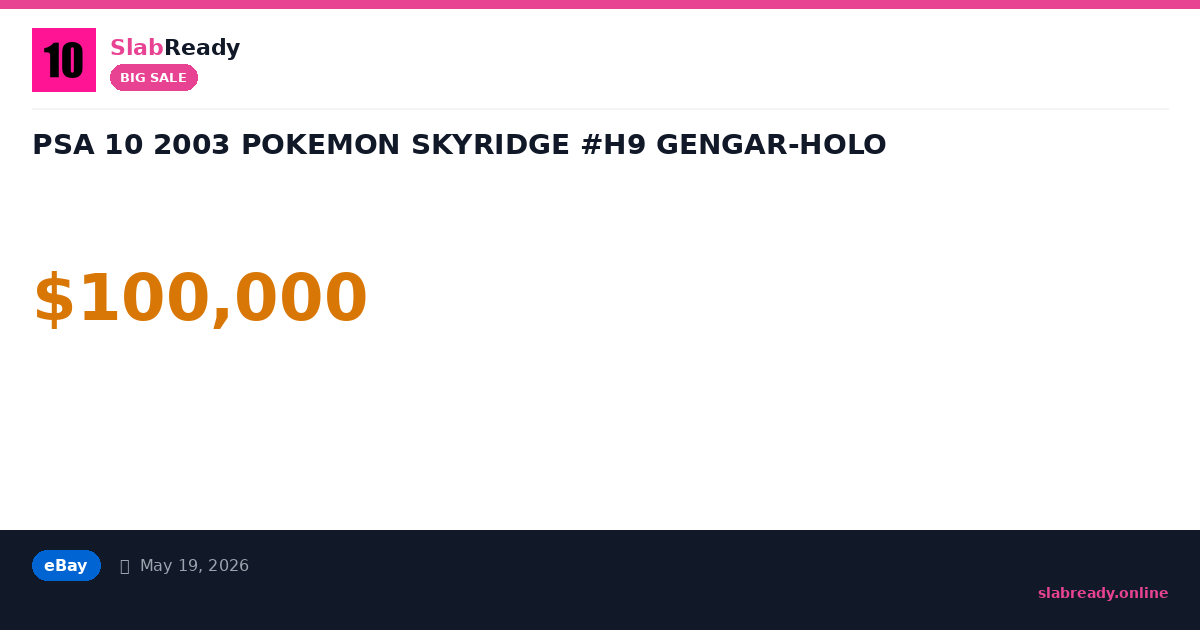
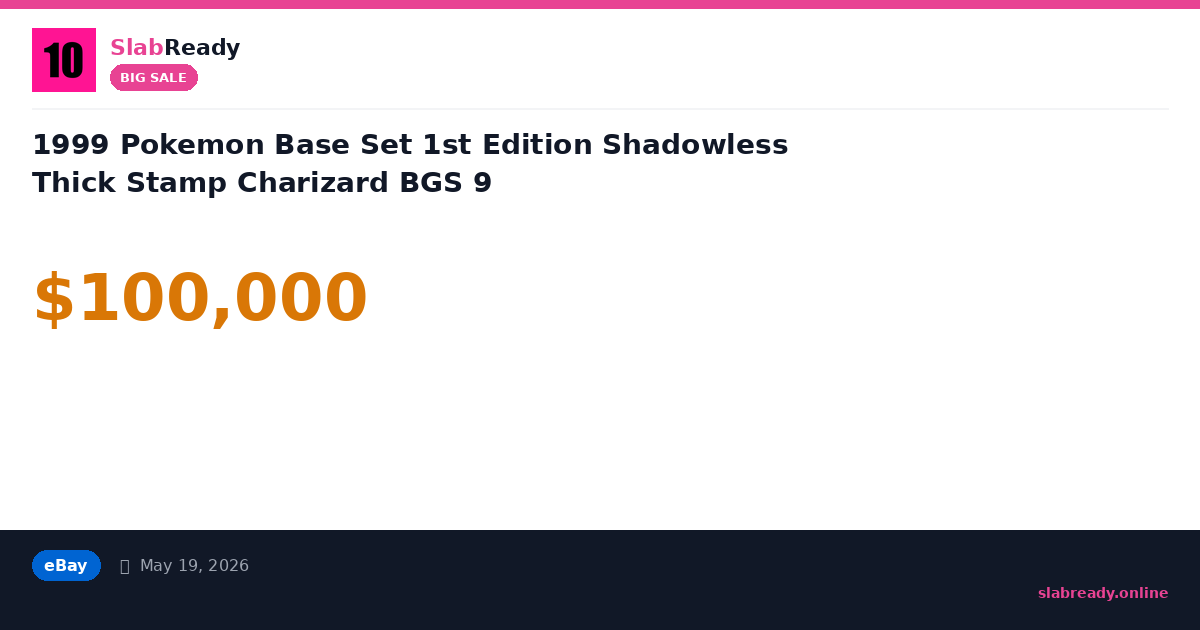
Recent high-value Pokémon card sales tracked by SlabReady's market monitoring system.
📌 The Pikachu Illustrator: A $6 Million Children's Art Prize
The Pikachu Illustrator is the rarest Pokémon card in existence. Only 41 copies were ever produced — awarded to winners of CoroCoro Comic's illustration contest in 1997-1998. The card features artwork by Atsuko Nishida (the original designer of Pikachu) and includes unique flavor text: "We certify that your illustration is an excellent entry in the Pokémon Card Game Illustration Contest."
A PSA 10 copy sold for $5.275 million in July 2021, with market estimates reaching $6 million as of 2026. Only a handful of copies grade above PSA 8. The gem rate of 2.4% applies to a pool of roughly 41 cards — meaning barely 1 card might qualify as PSA 10.
📊 Recent Big Sales — Live Data
The following table is loaded live from SlabReady's market tracking system, which monitors eBay for high-value Pokémon card transactions. These are real recent sales — not estimates.
Loading recent big sales from market tracker...
Data sourced from SlabReady's market pulse system. Updated continuously. Prices reflect eBay sold listings including buyer's premium where applicable.
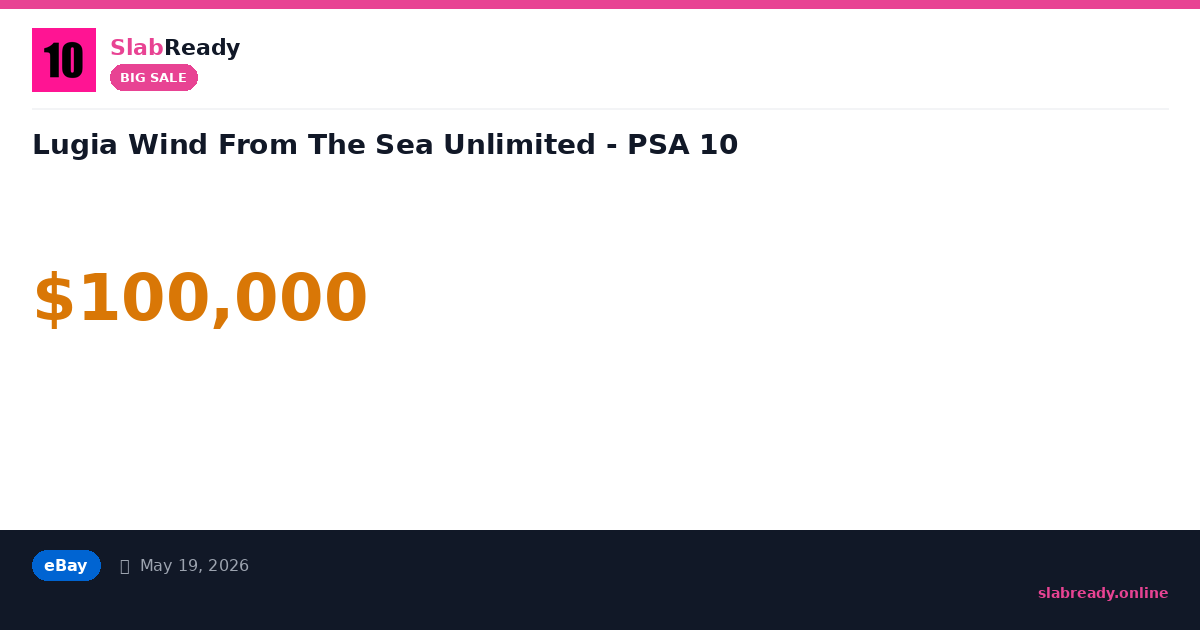
Lugia Wind From The Sea PSA 10 — $100,000 | Tracked via SlabReady's Big Sales Monitor
📈 Price Trends by Era — What Each Generation Is Worth
Pokémon card values vary dramatically by set era. Understanding which era a card comes from is the first step in understanding its value ceiling — and its investment potential.
WOTC Era (1998–2003)
Base Set through Skyridge. The most valuable era. 1st Edition and Shadowless cards command massive premiums. Gem rates of 3-6% make PSA 10s legitimately rare.
EX Era (2003–2007)
Gold Stars, Crystal Types, and ex cards. Underrated era with strong appreciation. Gold Star Pokémon (Charizard, Rayquaza, Umbreon, Espeon) are the standout collectibles.
Diamond & Pearl (2007–2010)
Includes Charizard G Lv.X ($6,000 PSA 10) and Lv.X cards. Less collected than WOTC era but growing. Gem rates of 6-8%.
Black & White / XY (2011–2016)
Full Art Supporters (N, Colress) and early EX cards drive this era. N Full Art hits $3,500 PSA 10. Gem rates of 8-16%.
Sun & Moon (2017–2019)
GX cards, rainbow rares, and Alt Art Tag Teams. Charizard GX Rainbow Rare ($3,500), Hidden Fates shiny vault cards lead the era.
Sword & Shield (2020–2022)
Alt Art VMAX cards from Evolving Skies dominate: Umbreon VMAX Alt Art ($2,800), Rayquaza VMAX Alt Art ($1,800). Pandemic-era boost stabilized at strong levels.
Scarlet & Violet (2023–2026)
SAR (Special Art Rare) cards lead with Charizard ex SAR Prismatic Evolutions ($3,500). High gem rates (20-25%) mean PSA 10s are attainable. Premium over raw is lower than vintage.
Japanese Exclusives
Eevee Heroes Japanese set stands out with Umbreon VMAX Alt Art ($3,500) and Glaceon VMAX Alt Art ($1,500). Japanese prints often have cleaner finishes and slightly higher gem rates.
What Makes a Pokémon Card Valuable? The Six Factors
Not all Pokémon cards are created equal. The cards that sell for thousands or millions share a combination of these six characteristics. The more factors a card has, the higher its ceiling.
1. Rarity — How Many Copies Exist?
According to PSA's population report, the Pikachu Illustrator has only 41 known copies. The 1st Edition Charizard has thousands of submissions but very few in high grades — with a gem rate of just 3.8% per PSA data. A modern Scarlet & Violet SAR card might have tens of thousands in PSA 10. Scarcity is the foundation of value — but it interacts with demand. A card can be rare and worthless if nobody wants it.
2. Condition — PSA Grade
Condition is the single biggest swing factor in card value. Based on recent eBay sold listings as of August 2026, a 1st Edition Charizard in PSA 7 condition sells for approximately $8,000. The same card in PSA 10 sells for $420,000 — a 52x difference based purely on grade. For modern cards, the PSA 10 premium is typically 5–15x the raw value. For vintage cards, it's often 20–50x or more.
Not sure if your card is worth submitting to PSA? Use our grading calculator to estimate whether grading will be profitable, or download SlabReady for a full AI-powered grade prediction.
The four categories PSA grades on (all equally weighted): Centering, Corners, Edges, Surface. Any significant defect in any category prevents a PSA 10.
3. Character Popularity
Charizard appears in more of the top-value cards than any other Pokémon — by a wide margin. Pikachu (the franchise mascot), Mewtwo, Lugia, Rayquaza, and the Eevee evolutions (especially Umbreon and Espeon) also command strong premiums. Character popularity is driven by both the original games and the TCG artwork — alt art cards with beautiful illustrations can spike values even for non-iconic Pokémon.
4. Print Era — 1st Edition, Shadowless, Unlimited
For Base Set cards, print variant determines a huge portion of the value:
- 1st Edition (most valuable)
- Small stamp on the left side of the artwork. First print run only. Charizard 1st Ed PSA 10: $420,000.
- Shadowless (second most valuable)
- No shadow behind the artwork box. Early unlimited run. Charizard Shadowless PSA 10: ~$100,000-150,000.
- Unlimited (most common)
- Has shadow, mass print. Charizard Unlimited PSA 10: ~$42,000.
5. PSA Population & Gem Rate
According to PSA's population report data, each card's submission history and grade distribution is publicly tracked. A card with a PSA 10 population of 5 is worth far more than the same card with a PSA 10 population of 5,000. The gem rate (% of submissions that grade PSA 10) tells you how difficult it is to achieve that top grade — which determines scarcity of PSA 10 copies.
Gem rates by era: WOTC-era cards typically gem at 3-6%. EX-era cards at 3-7%. Diamond & Pearl era at 6-10%. Modern Scarlet & Violet cards at 20-25%. The lower the gem rate, the more a PSA 10 is worth relative to lower grades.
6. Historical Significance & Backstory
Cards with unique backstories command premium attention. The Pikachu Illustrator's story as an art contest prize adds to its mystique. Error cards (misprint, wrong colors, off-center factory errors) can be extremely valuable in certain cases. Trophy cards awarded at tournaments and championship events are among the rarest Pokémon items in existence.
Where Big Pokémon Card Sales Happen
Understanding the venues for high-value Pokémon card sales helps both buyers and sellers navigate the market intelligently.
eBay — The World's Largest Card Marketplace
The majority of Pokémon card sales by volume happen on eBay. For high-value cards ($1,000+), eBay's buyer protection, search visibility, and global reach make it the default marketplace. eBay charges sellers approximately 13% in fees (listing fee + final value fee), which smart sellers factor into pricing. The biggest advantage of eBay is price discovery — you can see exactly what comparable cards have sold for. SlabReady tracks eBay sold listings in real-time to provide current market prices.
Heritage Auctions & PWCC
For cards over $10,000, traditional auction houses like Heritage Auctions and PWCC (now part of Fanatics) are the preferred venue. According to Heritage Auctions' public records, they have handled several of the most expensive Pokémon card sales in history, including multiple six-figure Charizard transactions. PWCC brokered the $5.275 million Pikachu Illustrator sale in . Auction houses charge buyers a "buyer's premium" of 15–25% on top of the hammer price — so a $100,000 hammer price means $115,000–$125,000 out of pocket for the buyer.
"The Pikachu Illustrator is to Pokémon cards what the Mona Lisa is to art — it defines the entire category and sets the ceiling for what a trading card can be worth." — Market analysis based on Heritage Auctions and PWCC sale records
Fanatics Collect
Fanatics Collect (formerly PWCC Marketplace) is growing rapidly as a dedicated graded card marketplace. With authentication built in and a focus on PSA, BGS, and CGC graded cards, it's become a strong venue for mid-to-high range sales ($500-$50,000 range). The integration with Fanatics' broader sports ecosystem is driving new collectors to the platform.
Private Sales
The very highest Pokémon card transactions often happen privately — between collectors, brokered by dealers or auction houses acting as intermediaries. Private sales benefit sellers (no fees, no public price discovery) and buyers (potential to negotiate below market). The downside: no price transparency and counterparty risk. Most private sales in the seven-figure range involve third-party authentication and legal agreements.
Card Shows & Conventions
The National Sports Collectors Convention (NSCC), regional card shows, and Pokémon-focused events facilitate significant in-person transactions. Show floor sales typically happen at or slightly below market value — dealers need to move inventory, and buyers can inspect cards directly. For cards under $500, shows are often the best place to find deals. You can also find underpriced PSA 10 slabs on our live deals page, which scans eBay in real-time for mispriced listings.
The Investment Case for Pokémon Cards
Pokémon cards as investments have a real track record, but require nuance. The market went parabolic in 2020-2021 (driven by pandemic boredom, YouTuber pack openings, and speculative demand), then corrected significantly through 2022-2023. As of 2026, prices have stabilized at levels that are still 3-5x higher than pre-2020 prices for most vintage cards.
Long-Term Performance — Key Data Points
- PSA 10 1st Edition Charizard: ~$10,000 in 2015 → $420,000 in 2026 (42x in 11 years)
- PSA 10 Base Set Unlimited Charizard: ~$2,000 in 2015 → $42,000 in 2026 (21x in 11 years)
- PSA 10 Pikachu Illustrator: ~$100,000 in 2015 → $6,000,000 in 2026 (60x in 11 years)
- PSA 10 Umbreon VMAX Alt Art (Evolving Skies): launched at ~$600 in 2021 → $2,800 in 2026 (4.7x in 5 years)
The strongest performers have been PSA 10 copies of iconic WOTC-era cards with low gem rates, according to historical price data from eBay sold listings and Heritage Auctions records. These are the cards where condition is hardest to achieve, character is most beloved, and the buyer pool is global. Modern cards (post-2019) are more accessible and liquid but carry more price volatility — they're more trading than investing for most collectors.
"The Pokémon market has matured from a speculative frenzy into a structured alternative asset class — vintage PSA 10s with sub-5% gem rates now trade with the consistency and liquidity you'd expect from blue-chip collectibles." — Analysis based on 2015–2026 price trends from PSA, Heritage Auctions, and eBay market data
The most important rule in Pokémon card investing: condition is everything. Buying raw cards without pre-screening condition is speculation. Buying graded cards from reputable graders (PSA, BGS, CGC) at fair prices is investing. The spread between a PSA 9 and a PSA 10 for vintage cards is enormous — getting the grade right is the entire game.
Interested in sports card investing too? See our companion guide: The Biggest Sports Card Sales of 2026.
Know your card's grade before you buy, sell, or submit.
SlabReady's 9-angle AI scan predicts your PSA grade in 30 seconds — with sub-scores, defect maps, and the full profit/loss calculation.
Download SlabReady FreeTop Pokémon Cards to Watch in 2026
Based on current market conditions, PSA population trends, and character popularity, these are the Pokémon cards with the strongest momentum and investment thesis in 2026:
Vintage (WOTC Era) — Still the Safest Long-Term Plays
- Charizard 1st Edition PSA 10 — The benchmark. Fewer than 120 PSA 10 copies exist from over 3,000 submissions. Price: $420,000.
- Lugia Neo Genesis 1st Edition PSA 10 — Fewer than 100 PSA 10 copies. Growing collector base. Price: $80,000.
- Base Set Unlimited Charizard PSA 10 — More accessible entry point to the classic. Still appreciated 21x since 2015. Price: $42,000.
EX Era — Undervalued with Strong Upside
- Charizard Gold Star PSA 10 — Only 3.2% gem rate. One of the hardest cards to achieve PSA 10. Price: $60,000.
- Umbreon Gold Star PSA 10 — Eevee evolution popularity growing. 3.8% gem rate. Price: $45,000.
- Rayquaza Gold Star PSA 10 — Strong character demand. Limited supply of PSA 10s. Price: $45,000.
Modern — High Liquidity, Lower Barrier to Entry
- Umbreon VMAX Alt Art (Evolving Skies) PSA 10 — The most iconic modern alt art card. Strong secondary market. Price: $2,800.
- Charizard ex Tera Hyper Rare (Prismatic Evolutions) PSA 10 — 2025 set with strong collector demand. Price: $3,500.
- Pikachu with Grey Felt Hat Van Gogh Promo PSA 10 — Museum promo with cultural crossover appeal. Price: $2,500.
Frequently Asked Questions
What is the most expensive Pokémon card ever sold?
The most expensive Pokémon card ever sold is the Pikachu Illustrator promo, which sold for approximately $5.275 million in and is valued at $6 million as of August 2026. According to PSA's population report, only 41 copies of this card are known to exist — awarded to winners of a CoroCoro Comic illustration contest in 1997–1998. The sale was brokered privately by PWCC, according to their auction records.
How much is a 1st Edition Charizard worth in 2026?
A 1st Edition Shadowless Base Set Charizard (#4/102) is worth approximately $25,000 raw (ungraded) as of August 2026. In PSA 10 Gem Mint condition, it has sold for up to $420,000. PSA 9 copies trade at $60,000-90,000. The gem rate is 3.8%, meaning only about 1 in 26 submitted copies achieve PSA 10. The value depends heavily on whether it has the 1st Edition stamp, is the Shadowless variant, and how it grades.
Are Pokémon cards a good investment in 2026?
Pokémon cards can be excellent investments — PSA 10 copies of iconic WOTC-era cards have appreciated 20-60x since 2015. However, results vary enormously by selection. Vintage cards with low gem rates and iconic characters (Charizard, Pikachu, Lugia) have the strongest long-term track record. Modern cards (Scarlet & Violet era) are more speculative and liquid but carry more price volatility. Condition is everything — a PSA 10 can be worth 10-50x a PSA 8.
What Pokémon cards are worth the most money?
The top 5 most valuable Pokémon cards by PSA 10 value in 2026: (1) Pikachu Illustrator $6,000,000, (2) Charizard 1st Edition Base Set $420,000, (3) Blastoise 1st Edition Base Set $130,000, (4) Venusaur 1st Edition Base Set $95,000, (5) Lugia Neo Genesis 1st Edition and Crystal Charizard Skyridge tied at $80,000 each.
What makes a Pokémon card valuable?
Six factors drive Pokémon card value: (1) Rarity — how few copies exist in high grades; (2) Condition — PSA 10 vs PSA 9 can mean a 5-50x price difference; (3) Character popularity — Charizard, Pikachu, and Eevee evolutions carry permanent demand; (4) Print era — 1st Edition WOTC cards are the most valuable class; (5) PSA gem rate — lower means PSA 10 copies are more scarce; (6) Historical significance — promos, contest prizes, and tournament cards carry unique backstories that collectors pay up for.
Where do the biggest Pokémon card sales happen?
The biggest Pokémon card sales happen through: (1) Heritage Auctions and PWCC/Fanatics for cards over $10,000; (2) eBay for the majority of $500-$10,000 transactions; (3) Fanatics Collect for graded card sales; (4) Private sales for seven-figure deals. Card shows are best for sub-$500 deals and in-person inspection.
What is the difference between 1st Edition and Shadowless Pokémon cards?
1st Edition cards have a small stamp ("Edition 1" with a "1" in a circle) on the left side of the card artwork. These are the first print run and the most valuable. Shadowless cards are from the early unlimited print run — they have no shadow behind the artwork box but lack the 1st Edition stamp. Unlimited cards have the shadow visible under the artwork box and are the most common variant. For a Charizard PSA 10: 1st Edition ~$420,000 vs Shadowless ~$120,000 vs Unlimited ~$42,000.
What modern Pokémon cards are worth the most?
The most valuable modern Pokémon cards (2019-2026) in PSA 10 as of August 2026: Charizard ex Tera Hyper Rare from Prismatic Evolutions ($3,500), Umbreon VMAX Alt Art from Evolving Skies ($2,800), Pikachu with Grey Felt Hat Van Gogh Promo ($2,500), Pikachu VMAX Rainbow from Vivid Voltage ($1,800), Rayquaza VMAX Alt Art from Evolving Skies ($1,800), and Umbreon VMAX Alt Art from Eevee Heroes Japanese ($3,500).
How do I know if my Pokémon card is worth grading?
A Pokémon card is worth grading when the PSA 10 value minus grading cost ($30-50 per card at the cheapest tier) exceeds the raw card value with sufficient margin. For most cards, the math requires the PSA 10 value to be at least 3x the raw value AND your specific copy to have a strong chance of grading 10. Use SlabReady's 9-angle AI scan — it gives you a predicted grade, confidence percentage, and the full profit/loss calculation before you spend a dollar on grading.
What is a PSA gem rate and why does it matter?
The gem rate is the percentage of submitted copies of a card that grade PSA 10 (Gem Mint). A 3% gem rate means only 3 in 100 submissions achieve the top grade. Gem rate directly controls the scarcity — and therefore the price premium — of PSA 10 copies. WOTC-era cards have 3-6% gem rates (very hard). Modern Scarlet & Violet cards have 20-25% gem rates (attainable). The lower the gem rate, the more valuable a PSA 10 is relative to PSA 9 or raw copies.
Check any Pokémon card's grade, value, and profit potential.
3 free deep scans. 9-angle AI analysis. Grade prediction, defect map, PSA population data, and the full financial picture in 30 seconds.
Download Free on App Store